
Pump stations are an essential but frequently neglected part of many commercial drainage systems. Because they are buried underground and out of sight, they can go years without a proper inspection – until something fails.
When a pump station fails, the consequences for a business can be immediate and serious: wastewater backing up into buildings, uncontrolled discharge, regulatory scrutiny and costly emergency callouts. Most of these failures are preventable with a structured maintenance programme. For commercial operators, maintenance is not simply good practice – it is a legal requirement.
Who Is Responsible for a Commercial Pump Station? 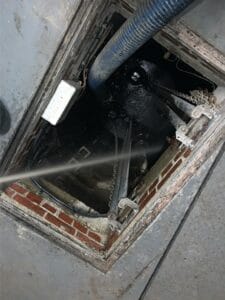
Pump stations – also known as sewage pumping stations or lifting stations – are used wherever gravity alone cannot move wastewater from a lower point to a higher discharge point. On commercial and industrial sites they are common where:
- Buildings or facilities sit at a lower level than the main sewer connection
- Sites are spread across multiple levels or have drainage that needs lifting across significant distances
- Premises are in areas without direct access to a gravity sewer
- Developments include car parks, basements or below-ground facilities
Under the Environmental Protection Act 1990, operators responsible for managing waste removal have a legal duty to prevent pollution, maintain system integrity and respond promptly to failures. Where a pump station falls within the boundary of a private commercial property, the responsibility for its maintenance sits with the property owner or operator. Failure to maintain a compliant and functional system can result in enforcement action by the Environment Agency, financial penalties and significant reputational damage.
How Often Should a Commercial Pump Station Be Serviced?
Industry guidance is clear: commercial pump stations should be serviced at least every six months as a minimum. Higher-usage installations – such as those serving food production facilities, large office complexes, schools or industrial sites – may require more frequent attention depending on throughput and the nature of the waste being handled.
The pump manufacturer’s documentation will often specify recommended service intervals for your particular installation. If this documentation is unavailable or the station has changed hands, a qualified drainage contractor can advise on the appropriate frequency based on the make, model and operational conditions.
Many commercial operators choose a pre-planned maintenance contract, which schedules visits at agreed intervals, removes the risk of maintenance being overlooked and provides documented service records – useful evidence of due diligence in the event of an Environment Agency inspection or insurance claim.
What Gets Missed – The Most Overlooked Maintenance Tasks
Even when pump stations are visited regularly, certain checks are frequently skipped – either because they are time-consuming, require specialist equipment or fall between the responsibilities of different contractors. The tasks most commonly missed on commercial sites include:
Float switch testing
Float switches control when the pump activates and when it shuts off. They can become tangled, coated in fats, oils and grease (FOG), or stuck in a fixed position – meaning the pump either runs continuously, burning out the motor, or fails to activate when the wet well reaches operating level. Testing each float under operational conditions, not just a visual inspection, is essential at every service.
Alarm function verification
Most pump stations have a high-level alarm designed to alert operators when the wet well is filling beyond normal working levels. Alarms are commonly tested at installation and then left unchecked. A non-functional alarm means a developing fault can go unnoticed until the station overflows – with potential environmental and regulatory consequences for the site operator.
Wet well cleaning and de-silting
The wet well accumulates silt, grease and debris over time. This build-up reduces effective storage volume, increases wear on pump components and creates conditions that accelerate internal corrosion. Regular cleaning using high-pressure jetting and vacuum tanker removal is one of the most impactful maintenance tasks and one of the most commonly deferred.
Rising main inspection
The rising main carries pressurised sewage away from the pump station to the discharge point. It can develop blockages, air locks or joint failures that restrict flow and place additional load on the pump. A full service should confirm the rising main is clear and that non-return valves are seating and opening correctly.
Electrical and control panel checks
Control panels housed in kiosks adjacent to the pump station are exposed to damp, condensation, insects and temperature fluctuation. Connections can corrode, motor protection settings can drift out of specification and fuses can fail without being noticed. These checks require a competent person and must not be skipped – a panel fault can prevent the pump from operating even when the pump itself is in perfect condition.
Warning Signs of a Failing Pump Station
Between planned services, site and facilities managers should watch for the following indicators:
- Unusual noises from the pump – grinding, rattling, or irregular on/off cycling
- The high-level alarm activating more frequently than normal
- Slow or sluggish drainage across connected facilities
- Foul odours near the pump station or surrounding manhole covers during dry weather
- Visible moisture, corrosion or physical damage around the kiosk or access covers
- Unexplained increases in energy consumption where pump station usage is monitored
None of these signs should be logged and left. In most cases, catching a developing fault at this stage means a repair rather than a full component replacement.
The Cost Argument: Planned Maintenance vs Emergency Response
Emergency pump station failures on commercial sites typically involve out-of-hours engineer callouts, specialist tanker hire to manage overflow, temporary pump hire while replacement parts are sourced and, in the worst cases, an Environment Agency pollution incident investigation. The combined costs can run to several thousand pounds – plus operational disruption and the management time involved in responding.
A pre-planned maintenance contract removes this exposure. Visits are scheduled to minimise disruption to site operations, all key checks are carried out systematically, and emerging issues are identified and resolved before they develop into failures. Costs are predictable, compliance records are maintained, and the risk of an uncontrolled incident is substantially reduced.
Pump Station Maintenance from Drain & Sewer Services
We provide pump station cleaning, inspection and maintenance services for commercial, industrial and managed estate clients across Hampshire, Surrey, Berkshire and the surrounding areas. Our teams are experienced in servicing a wide range of pumping installations and can provide both one-off inspections and structured pre-planned maintenance agreements.
If you are unsure when your pump station was last properly serviced, or if you have noticed any of the warning signs above, get in touch. We can carry out an initial inspection and advise on the appropriate maintenance schedule for your installation.
Call us on 01252 312738 or email info@drainandsewer.co.uk.
Frequently Asked Questions
Who is responsible for maintaining a commercial pump station?
Where a pump station sits within the boundary of a private commercial property, the responsibility for its maintenance lies with the property owner or operator. Under the Environmental Protection Act 1990, operators have a legal duty to prevent pollution and maintain system integrity. Pumping stations that serve multiple private properties and meet eligibility criteria may have been transferred to the responsibility of the local sewerage company under 2016 regulations – if you are unsure, your sewerage company can confirm.
How often should a commercial pump station be serviced?
The industry standard for commercial pump stations is a minimum of every six months. Higher-usage sites or those handling waste from food preparation, manufacturing or other demanding processes may require more frequent servicing. Your pump manufacturer’s documentation and your drainage contractor can advise on the right interval for your specific installation.
What happens if a commercial pump station is not maintained?
A poorly maintained pump station is at significantly higher risk of failure. In the event of an uncontrolled discharge or pollution incident, the Environment Agency may investigate and enforcement action can follow, including fines. Insurance claims may also be complicated if a lack of documented maintenance is identified as a contributing factor.
What is included in a pump station service?
A thorough commercial pump station service should include wet well cleaning and de-silting, float switch testing, alarm verification, rising main inspection, non-return valve checks, pump performance testing and electrical/control panel inspection. At Drain & Sewer Services we provide a written service record following every visit.
