
For facilities managers and commercial property owners, subsidence is one of the most serious structural issues a site can face. Cracks in walls, sticking doors, uneven floors – these are the warning signs that typically prompt a call to a structural engineer or an insurance claim. But what many businesses don’t realise is that their drainage system could be at the root of the problem.
Drainage-related subsidence is more common than you might think, particularly on older commercial sites, industrial premises and managed estates where underground pipework has never been formally inspected. Understanding the link – and acting early – can prevent far more significant and costly structural damage further down the line.
What Is the Link Between Drains and Subsidence? 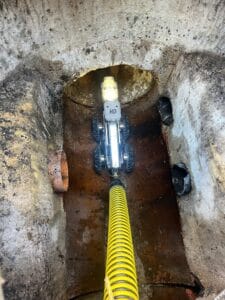
Subsidence occurs when the ground beneath a structure loses stability and shifts, causing foundations to move unevenly. While clay soils, tree roots and historic mining activity are well-known contributing factors, leaking or damaged underground drainage is a frequently overlooked cause – particularly on commercial and industrial sites where pipe runs can be extensive and long-established.
When a drain develops a crack or joint failure, wastewater escapes into the surrounding soil. Over time, this water washes away the fine particles that give the ground its load-bearing structure, creating voids beneath foundations. Once those voids expand sufficiently, the ground can no longer support the weight above it and movement begins. Even a slow, small leak can have a significant cumulative impact over months and years – and because it all happens underground, it is often well advanced before anything appears at surface level.
Warning Signs That Drainage May Be the Cause
Not every incidence of subsidence is drainage-related, but there are signs that point specifically towards a drainage cause. On commercial sites, be alert to:
- Diagonal cracks appearing at corners of windows or door frames – typically narrow at the bottom and wider at the top
- Doors, roller shutters or access points that have recently started sticking or no longer closing correctly
- Depressions, sinking or soft areas in car parks, yards, access roads or paved surfaces near drainage runs
- Persistently waterlogged ground in areas not near a watercourse or irrigation system
- A recurring foul odour in external areas during dry weather
- Slow-draining facilities across the site that have not responded to standard unblocking
If multiple signs are appearing together, drainage should be one of the first things investigated – not left until other causes have been ruled out.
Why Drainage Gets Missed in Subsidence Investigations
Structural engineers and loss adjusters typically focus their initial investigations on foundation depth, soil type and nearby vegetation. These are all valid factors. However, the drainage system is sometimes only brought into consideration after everything else has been examined – by which point considerable repair work may already be unavoidable.
A CCTV drain survey is a quick, non-invasive and relatively low-cost first step that can either confirm or rule out drainage as a contributing factor. On commercial sites with extensive below-ground infrastructure, it should be part of any early-stage subsidence investigation, not an afterthought.
How a CCTV Drain Survey Can Help 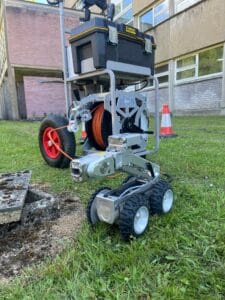
A CCTV drain survey passes a camera through the pipework to inspect its internal condition. It can identify cracks, fractures, displaced joints, root ingress, deformation and areas of collapse – and pinpoint exactly where water may be escaping into the surrounding ground.
The survey produces a detailed report with footage and findings. For commercial operators, this documentation is valuable not only for planning repairs but also for insurers and structural engineers who need evidence of drainage condition as part of a wider investigation.
Drain & Sewer Services carries out full CCTV drain surveys across commercial, industrial and managed residential sites in Hampshire, Surrey, Berkshire and the surrounding areas. We use specialist crawler systems for larger-diameter pipes and produce comprehensive survey reports suitable for insurance and engineering use.
What Happens If the Drains Are the Problem?
If the survey identifies damaged or leaking pipework, the repair method will depend on the location, depth, diameter and condition of the pipe. Options typically include:
- Drain re-lining – a no-dig solution where a resin-impregnated liner is cured in place inside the existing pipe, sealing cracks and restoring structural integrity without excavation
- Patch lining – targeted repair to a specific section of pipe where the surrounding pipework remains sound
- Excavation and replacement – where a pipe has collapsed or cannot be re-lined, sections are dug out and replaced
Repairing the drainage removes the source of water ingress. In more advanced cases, additional groundwork may be needed to stabilise soil before structural repairs are carried out. Acting early gives the best chance of a straightforward resolution and significantly reduces overall remediation costs.
Don’t Wait for the Cracks to Tell You There’s a Problem
For commercial property owners and facilities managers, a proactive CCTV drain survey is a practical way to understand the condition of your below-ground drainage before problems emerge at surface level. It is non-invasive, provides clear documented results and takes significantly less time than most structural investigations.
Drain & Sewer Services provides CCTV drain surveying across Hampshire, Surrey, Berkshire and the surrounding areas. To arrange a survey or discuss your requirements, call us on 01252 312738 or email info@drainandsewer.co.uk.
Frequently Asked Questions
Can blocked drains cause subsidence?
Blocked drains can contribute to subsidence by causing water to back up and overflow into surrounding soil. However, the more common drainage cause is a cracked or leaking pipe that allows wastewater to escape gradually into the ground over a long period, eroding the soil structure beneath foundations.
How do I know if my commercial property is at risk of drainage-related subsidence?
Properties on clay soils, older sites with clay or pitch-fibre pipework, and premises where drains have not been inspected for a number of years carry a higher risk. A CCTV drain survey is the most reliable way to assess the current condition of your underground drainage.
Does insurance cover subsidence caused by drains?
Most commercial property insurance policies include subsidence cover, but the terms vary. Insurers will typically want to establish the cause of any movement before agreeing to cover repairs. Having a CCTV survey report that documents the drainage condition can help support a claim and speed up the investigation process.
How quickly can drainage-related subsidence develop?
It depends on soil type, the size of the leak and the volume of water involved. On sandy or loose soils, ground movement can develop relatively quickly. On clay soils, the process is often slower but the effects can be more severe once movement begins. Either way, early identification and repair gives the best outcome.
