
On paper, we are still in a drought. The Environment Agency’s latest weekly report, covering 25 September to 1 October, has ten areas in drought status, including Solent and South Downs, Kent and South London, Thames, and Hertfordshire and North London. England received 65% of its long-term average rainfall in September, and in east and south-east England it was nearer half. Reservoir storage for England stood at 55%, and the report says further significant rainfall is needed to return to normal water resource conditions for many water companies.
The weather is also changing. The Met Office has said it expects a very large El Niño to increase the chances of wetter, stormier conditions for the UK this autumn and early winter. That is a shift in the odds rather than a forecast for any particular week. But it matters, because the rain we need to end a drought and the rain our drains can cope with are not always the same thing.
Add falling leaves to that, and you have a combination worth planning for.
Why heavy rain after dry weather can flood drains
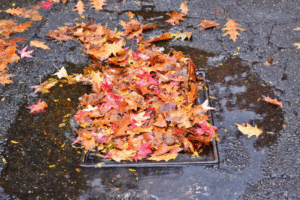
Fallen leaves can block gullies within weeks, so heavy rain has nowhere to go.
Thames Water, in a warning issued alongside Met Office thunderstorm alerts, put it plainly: after very dry conditions the risk of flooding is higher than you might expect, because dry, compacted ground struggles to absorb water quickly. Intense rainfall then runs off surfaces and can overwhelm drains.
For a commercial site, that matters because yards, car parks and access roads already shed water. If the ground beside them is not taking its usual share, more of the rain ends up in your gullies, channels and pipework, and a drain that copes in a normal year has less room for error.
Where falling leaves come in
Leaves are a seasonal drainage problem every year. Gloucestershire County Council, which looks after nearly 130,000 gullies and kerb weirs, says fallen leaves are likely to cause blockages and potentially localised flooding through autumn and winter. That is one county’s figure, but it gives a sense of the scale of the job across the country.
Councils do clear them. Surrey County Council, for example, says it cleans most road drains once a year and clears leaf-blocked drains as part of its normal gully programme, prioritising the sites that cause the most inconvenience. Leaves, however, arrive over a few weeks, and a gully that was clear in the spring can be blocked by November.
There is also a limit to what council drains cover. Surrey points out that road drains are designed to deal with water from the road and pavement. The drainage on your own site, the gutters, yard gullies, car park drains, channels and surface water pipework, is yours to look after, and no council programme will get to it.
What to check before the next heavy rain
A short walk round the site now is far cheaper than a flooded loading bay later. If you manage a commercial or industrial site, it is worth checking:
- gutters and downpipes, particularly under or near overhanging trees
- yard, car park and access road gullies and channel drains
- inlet grilles and trash screens at balancing ponds and surface water outfalls
- soakaways, bearing in mind that dry-looking ground is not proof that a soakaway will drain well
- low spots where water has collected during previous downpours
If anything is already slow to drain or holding debris, our drain cleaning and gutter cleaning services can clear it before the weather turns.
Clearing leaves safely
Councils give sensible advice if you are clearing a gully yourself. Gloucestershire asks people to clear only drains they can reach safely from the pavement, in daylight and outside peak traffic, using a broom, long stick or fork, and to avoid raking leaves uphill or into the road because they simply wash back into the drain.
On commercial sites, anything that means going into a chamber or manhole is a different matter. Entry into those spaces is confined space work and needs proper assessment and planning, as we explain in our guide to confined space entry in drains and sewers.
When it is more than leaves
Clearing leaves from a grate fixes a surface problem. If water is still backing up afterwards, the cause is deeper in the pipe, whether that is silt, a collapsed section or a damaged joint. Surrey’s own guidance acknowledges this, noting that jetting cannot fix problems such as broken pipes.
That is where high-pressure water jetting and a CCTV drain survey come in. Jetting clears the line, and a survey shows what is actually down there, so you are repairing the real fault rather than guessing.
How we can help
Drain & Sewer Services has more than 50 years’ experience of drainage and sewer work across the South of England, and our 24-hour emergency service runs every day of the year if heavy rain does catch you out. If you would rather get ahead of it, we can inspect and clear your site’s drainage before winter.
Call us on 01252 312738 or email info@drainandsewer.co.uk to arrange a visit.
Frequently asked questions
Is England still in drought if it is raining?
Yes. The Environment Agency’s latest report has ten areas in drought status and says further significant rainfall is needed to return to normal water resource conditions. A few wet days do not refill reservoirs or groundwater.
Why does heavy rain after a dry spell cause flooding?
Dry, compacted ground struggles to absorb water quickly, so intense rainfall runs off surfaces and can overwhelm drains.
Who is responsible for clearing leaves from drains?
Road gullies are normally looked after by the highway authority, such as the county council. Drains, gutters and gullies on private property, including commercial sites, are the owner’s responsibility.
What should a commercial site check before winter?
Gutters and downpipes, yard and car park gullies, channel drains, balancing pond inlets and screens, and soakaways. If water is slow to drain after clearing debris, a jetting and CCTV survey will find the cause.
