
Halloween is the season for things that lurk below, and under a surprising number of our streets, something does. Not ghosts, but rivers. They were not drained away or lost, they were buried, built over and, in many cases, turned into sewers that are still in use today.
London is the best documented example, because its museums have done the work of tracing them. The stories are a good reminder that what runs beneath a town is often older, stranger and more important than most people realise.
Rivers that were buried, not removed 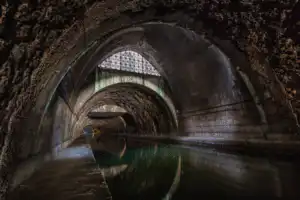
The London Museum describes how, over hundreds of years, many of London’s rivers and streams were abandoned, buried under the streets or converted into the sewage system. Clues to where they ran survive in street names and in the layout of roads and buildings.
The Fleet flows from Hampstead and Highgate down to Blackfriars Bridge. It was the western boundary of Roman Londinium, and the Romans built the first bridge over it, on the route that became Fleet Street. As London grew, it also became an open-air sewer. Medieval monks complained to the king about its smell as far back as the 1200s, and by 1710 Jonathan Swift was describing it carrying everything from butchers’ waste to drowned puppies. After the Great Fire, Christopher Wren turned the lower part into a canal, but the pollution was so relentless that it was gradually covered over from 1733. Today it is fully underground and largely part of the sewer system. At Blackfriars, the Bazalgette Embankment now intercepts overspill at the old sewer exit and diverts it into the super sewer beneath the Thames.
The Walbrook ran from Shoreditch, under what is now the Bank of England, to the Thames at Cannon Street. It was central to Roman and medieval London, powering industry and dividing the city into halves. In the 1400s the lord mayor ordered its lower section covered over, and over the following century it was channelled into tunnels, until by 1600 it had completely disappeared from view. Archaeologists working in its valley have found Roman religious offerings and the Temple of Mithras, and, more eerily, 39 Roman skulls whose origin is still debated.
Rivers that refuse to stay buried
The Effra is the one that really shows what happens when you bury a river and forget about it. It ran through south London from Upper Norwood to Vauxhall, and as Brixton and Dulwich were built up in the 1800s it flooded several times. It was covered over between about 1820 and 1860 and, by 1865, connected into Bazalgette’s intercepting sewers.
That did not end the story. The London Museum records that the Effra sewer overflowed in 1914, flooding houses and forcing residents to evacuate, and that it was widened in 1935 after further floods. You can still see Victorian ventilation pipes, known as stink pipes, lining its route through Brixton. There is also a piece of folklore that a coffin from West Norwood Cemetery once drifted down the river into the Thames. The museum is clear that this is a myth, and that the Effra was always too small and shallow to carry one.
The Tyburn flows from the Hampstead hills to the Thames near Pimlico, passing under Mayfair and Buckingham Palace. It was once a source of clean drinking water, but by the 1860s it had been turned into a waste sewer. Some people still campaign to bring it back to the surface, although that would mean demolishing some of the capital’s most expensive buildings.
The Victorian tunnels still doing the work
Much of what buried these rivers was Joseph Bazalgette’s sewer network, built after the Great Stink of 1858. According to the London Museum, it involved 1,100 miles of drains feeding into 82 miles of brick-lined intercepting sewers, using 318 million bricks, and it was not finished until 1875. Bazalgette deliberately built the tunnels far larger than the city needed at the time. When he died in 1891, inner London’s population had more than doubled since he drew up his plans, and the sewers were still coping.
They are still part of London’s sewer system today, though not without strain. The same museum notes that sewers are sometimes blocked by fatbergs, and that its collection includes part of the Whitechapel fatberg, which weighed 130 tonnes. A 25 km, seven-metre-wide Thames Tideway Tunnel has since been built to stop waste being discharged into the Thames after heavy rain.
If you would like the wider story of how sewers developed from Roman times onwards, we cover it in our guide to the history of sewers.
Is this only a London story?
London is the best documented, but it will not be the only town where a stream was covered over or an old brick sewer is still doing its job. We cannot point to a single source that maps every town, and the London Museum’s own advice is a good place to start: look at street names, the layout of roads and old maps for clues to where a watercourse used to run.
For anyone who owns or manages a site in an older town centre, that history has a practical side. Old pipework, culverts and chambers do not always match what a drawing says, and the Effra’s history shows that a buried watercourse can still make itself felt when there is heavy rain.
Finding out what is actually down there
You do not need to dig up the car park to find out. A CCTV drain survey lets us see inside pipework and chambers, check their condition and locate defects. We have invested in advanced CCTV inspection technology, including an iPEK crawler system, to strengthen our inspection capability. Where silt has built up, sewer cleaning and de-silting can restore flow.
Older chambers and sewers can also mean confined spaces. Where physical entry is unavoidable, it needs the right assessment, equipment and training, which we cover in our guide to confined space entry in drains and sewers.
Drain & Sewer Services has more than 50 years’ experience working with drainage and sewer systems across the South of England. If you would like to know what is beneath your site, call us on 01252 312738 or email info@drainandsewer.co.uk.
Frequently asked questions
Are there rivers under UK towns?
Yes. The London Museum documents many rivers and streams in London that were buried under streets or converted into sewers, including the Fleet, Walbrook, Tyburn and Effra. Other towns may have similar histories, and street names and old maps are good places to look.
Is the River Fleet still flowing?
Yes, but underground. According to the London Museum, the Fleet is now fully underground and largely part of the sewer system.
Are Victorian sewers still in use?
Yes. Much of Joseph Bazalgette’s brick-lined network is still part of London’s sewer system, partly because he built the tunnels far larger than were needed at the time.
What is a lost river?
A river or stream that has been covered over, built upon or converted into a sewer or drain, so it is no longer visible at the surface, although the water often still flows underground.
Can a CCTV survey inspect old brick sewers?
CCTV surveys can be used to inspect the condition of drainage pipework and chambers without digging, and to locate defects. Whether a particular old sewer can be surveyed depends on its size, access and condition, so it is worth asking us to assess it.
