
Silt does not announce itself. It settles where water moves slowly, a little at a time, in gully pots, chambers, silt traps, culverts and the pipes between them. Most of the time nobody notices, because the drain still works. Then a heavy downpour arrives, and a system that has quietly lost some of its capacity is asked to cope with everything at once.
That is why it pays to look for the signs early, before the next heavy downpour finds them for you.
Where silt comes from and where it builds up 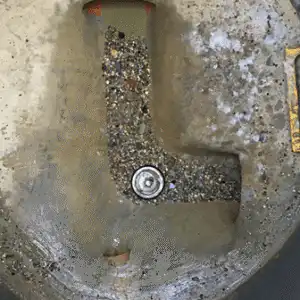
Silt is a mixture of fine soil, grit, sand and organic debris. It arrives with surface water running off yards, roads, verges and nearby land, and it settles wherever the flow slows down. That is why drainage on flat sites, and pipes laid with very little fall, tend to silt up over the years: the water never moves fast enough to carry the material away.
Silt rarely works alone. It builds up alongside leaves, grease, scale and anything else that finds its way into a drain, and together they narrow the pipe, slow the flow and sometimes cause bad smells. Add tree roots or a cracked pipe, and a partial blockage can become a full one.
The signs to look for
None of these proves silt is the cause, but each is worth investigating.
Water standing after the rain has stopped. A gully, channel or low spot that holds water long after a shower is one of the clearest signs that something downstream is restricting flow.
Ponding in the same places. Puddles that keep returning to the same spot on a yard, car park or access road suggest a gully that is not taking its share, or a pipe that is partly blocked.
Silt visible in gullies and chambers. If you lift a cover and the silt is close to the level of the outlet, the drain has lost much of its capacity.
Slow drains, gurgling and smells. Water that takes longer to leave sinks, floor drains or gullies, or odours around a drain, can all point to a build-up inside the pipe.
Mud or grit on surfaces after rain. If rain leaves a film of mud or grit on your yard or access road, the runoff is carrying material towards your drains. Sites next to fields, verges or construction work are especially prone to this.
Silt traps and interceptors that fill quickly. A trap that needs emptying more often than it used to, or has not been emptied for some time, is doing its job but running out of room.
Reduced flow at culverts and outfalls. Silt, vegetation and debris at the inlet or outlet of a culvert can restrict flow long before the culvert is blocked, and silt carried downstream gradually reduces the capacity of the channel it ends up in.
How we deal with silted drainage
If you are seeing any of these signs, the answer is rarely just clearing a grate. Silt sits in the pipes, chambers and traps you cannot see, and it usually means the whole system needs attention. This is how we approach it.
Finding the problem. A CCTV drain survey shows exactly where silt has built up, how much capacity has been lost and whether there is damage as well, such as cracks, root ingress or collapsed sections. That means the work is aimed at the real cause, not guesswork.
Clearing it. Our lorry-mounted combination units combine high-pressure jetting with suction. The jetting breaks up compacted and hardened silt, and the suction removes it from the system. We use them for sewer cleaning and de-silting, and to clean gullies, catchpits, culverts, storm systems, silt traps and oil water interceptors. As a registered waste carrier, we take away what we remove.
Working below ground. Deep chambers, culverts and pump stations sometimes need physical entry. Our teams are trained for confined space work and plan every entry properly, as we explain in our guide to confined space entry in drains and sewers.
Fixing the cause. If the survey shows a damaged or poorly laid pipe that keeps catching silt, we can repair or re-lay it so the problem does not come straight back.
Silt can build up to remarkable depths. On one waterway lock, almost two feet of silt across the entire base was blocking the movement of the outward flow gate. Our team cleared it and returned the lock to full working order. You can read more in our post on waterway lock cleaning.
Stopping it coming back
On a large site, silting is rarely a one-off problem. There are too many gullies, traps and culverts for anyone to keep an eye on, and the ones nobody looks at are the ones that fail. In autumn, fallen leaves add to the load, as we covered in our post on autumn leaves and blocked drains.
A pre-planned maintenance contract puts the cleaning and inspection of your site’s drainage on a schedule built around how it actually performs, so silt is removed before it causes a blockage, a flood or a call-out.
Drain & Sewer Services has more than 50 years’ experience of inspecting, unblocking and cleaning drains, sewers, culverts and gullies for businesses and public bodies across the South of England. If a problem cannot wait, our 24-hour emergency service is available every day of the year. To talk to us about your site, call 01252 312738 or email info@drainandsewer.co.uk.
Frequently asked questions
How do I know if my drains are silted up?
Typical signs are water standing after rain has stopped, ponding in the same places, slow drains, silt visible in gullies and chambers, mud or grit on surfaces after rain, and silt traps that fill faster than they used to. A CCTV survey can confirm it.
What causes silt to build up in drains?
Silt settles where water moves slowly. It arrives with surface water running off yards, roads and nearby land, and it combines with leaves, grease and other debris. Flat sites and pipes with very little fall are most prone to it, because the water never moves fast enough to carry it away.
How often should gullies and silt traps be cleaned?
It depends on the site, the surrounding land and how much runs through them. Gullies and traps in known problem areas need attention more often than the rest. A planned maintenance schedule sets the right frequency for each part of your site, and adjusts it as we learn how quickly each one fills.
Can you remove silt from a drain, culvert or sewer?
Yes. Our lorry-mounted combination units combine suction and jetting, so they can break up hardened silt and remove it, and clean culverts, storm systems, gullies, catchpits and silt traps.
