
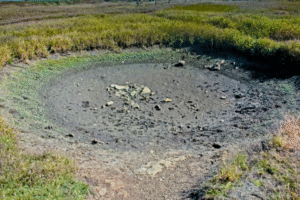
If your site relies on a borehole, private reservoir or other private water supply rather than mains water, this summer’s drought is likely to affect you more directly than most. The Environment Agency has begun issuing formal abstraction restrictions, and its most recent drought report suggests more are likely before the summer is over.
What’s actually being restricted
According to the Environment Agency, there are currently 1,534 restrictions in place on abstraction licences across England. In East Anglia specifically, the Environment Agency is communicating Section 57 restrictions to 302 abstractors, meaning a 50% reduction in what most of them can take from the environment. Formal restrictions may also be introduced in the Wye catchment in the West Midlands later in August if dry conditions continue.
For farms, equestrian centres, estates and other rural or semi-rural commercial sites with their own water supply, this isn’t a distant policy story. Reservoir storage for England has fallen to 69%, groundwater levels are in seasonal decline across all sites, and river flows are below normal or lower at the vast majority of locations the Environment Agency monitors.
Why this matters beyond the water supply itself
Falling groundwater doesn’t just affect how much water is available to abstract, it also affects what happens to water once it leaves your site. Septic systems rely on soil below and around a drainage field to disperse effluent, and soakaways rely on the surrounding ground being able to absorb what’s discharged into them. When groundwater levels drop significantly, that dispersal process can behave differently, sometimes for the better in the short term, but it’s also a sign that a soakaway or septic system operating at the margins of its capacity is worth checking now rather than waiting for a problem to appear.
The agricultural impact is already visible elsewhere. According to the Agriculture and Horticulture Development Board, this year’s harvest is the earliest in 20 years, with early evidence of lower yields for wheat, spring barley, oats and grassland. Livestock farmers are reporting pressure on winter forage stocks due to poor grass growth. None of this is unrelated to what’s happening below ground on the same sites.
How General Binding Rules compliance is assessed
Under the General Binding Rules, small sewage discharges to a watercourse or to ground are permitted without a full permit, provided certain conditions are met, including that the discharge doesn’t cause pollution. Those conditions don’t relax during a drought. If groundwater levels fall enough to change how a drainage field disperses effluent, or if a watercourse a system discharges to is running at exceptionally low flow, the same discharge that met the rules in a normal year can start to cause a problem this year, even without anything changing on-site.
The Environment Agency can still inspect a private system that falls under the General Binding Rules, and a system that’s clearly not coping with current ground conditions is a reasonable trigger for a visit. If you’re unsure whether your septic system or soakaway still meets the rules under this summer’s conditions, it’s worth checking now rather than waiting for a compliance issue to surface on its own.
Managing farm and irrigation reservoirs through an abstraction cut
For sites relying on a farm reservoir for irrigation or livestock water, a 50% abstraction cut doesn’t just mean using less water, it means changing how that water gets prioritised. Reservoirs that were topped up steadily through spring are now being drawn down faster than usual, and several sites nationally are already reporting rapid declines in storage. If your reservoir levels are falling faster than expected, it’s worth reviewing usage now, rather than discovering a shortfall midway through late summer irrigation or when livestock demand is at its highest.
What to check if you have a private water supply
- Your abstraction licence conditions. Check whether your catchment area has been issued restrictions, and whether further ones are likely.
- Borehole and reservoir levels. Monitor more frequently than usual, since conditions are changing quickly.
- Septic tank and soakaway performance. Look for signs of reduced capacity, unusual odours or slower dispersal, and book a service if it hasn’t been done this year.
- General Binding Rules compliance. If your septic system discharges to a watercourse or ground, confirm you’re still meeting the relevant standards under changing ground conditions.
- Farm and irrigation reservoirs. If storage is already low, plan ahead for irrigation and livestock water needs for the rest of the summer.
How Drain & Sewer Services can help
We service septic tanks, soakaways and cesspits for farms, estates and rural commercial sites across Hampshire, Surrey, Berkshire and the surrounding areas, and can advise on General Binding Rules compliance where private drainage is involved. If your site has a private water supply and you’re unsure how this summer’s conditions are affecting it, get in touch and we’ll arrange an inspection.
Call us on 01252 312738 or email info@drainandsewer.co.uk.
Frequently asked questions
What is a Section 57 abstraction restriction?
A Section 57 restriction is a formal notice from the Environment Agency reducing how much water an abstraction licence holder can take from a river, borehole or other source. In East Anglia, the current restriction means a 50% reduction for most affected abstractors.
Does a drought affect how my septic tank or soakaway performs?
Yes. Falling groundwater changes the conditions a septic system or soakaway relies on to disperse effluent. This can behave differently during a drought, and it’s a good reason to check your system’s condition rather than assume it’s unaffected simply because it hasn’t caused a visible problem.
Are more abstraction restrictions expected this summer?
The Environment Agency has indicated that formal restrictions may be introduced in the Wye catchment and the West Midlands later in August if dry conditions continue, in addition to those already in place in East Anglia.
Who should be concerned about abstraction restrictions?
Anyone with their own water supply rather than a mains connection, including farms, equestrian centres, estates and rural commercial sites with a borehole, private reservoir or other abstraction licence.
